Designing Dead-Letter Queues That Help You Recover Events
Learn how to design dead-letter queues with useful metadata, triage workflows, safe replay tools, and clear ownership so failed events can be recovered instead of ignored.
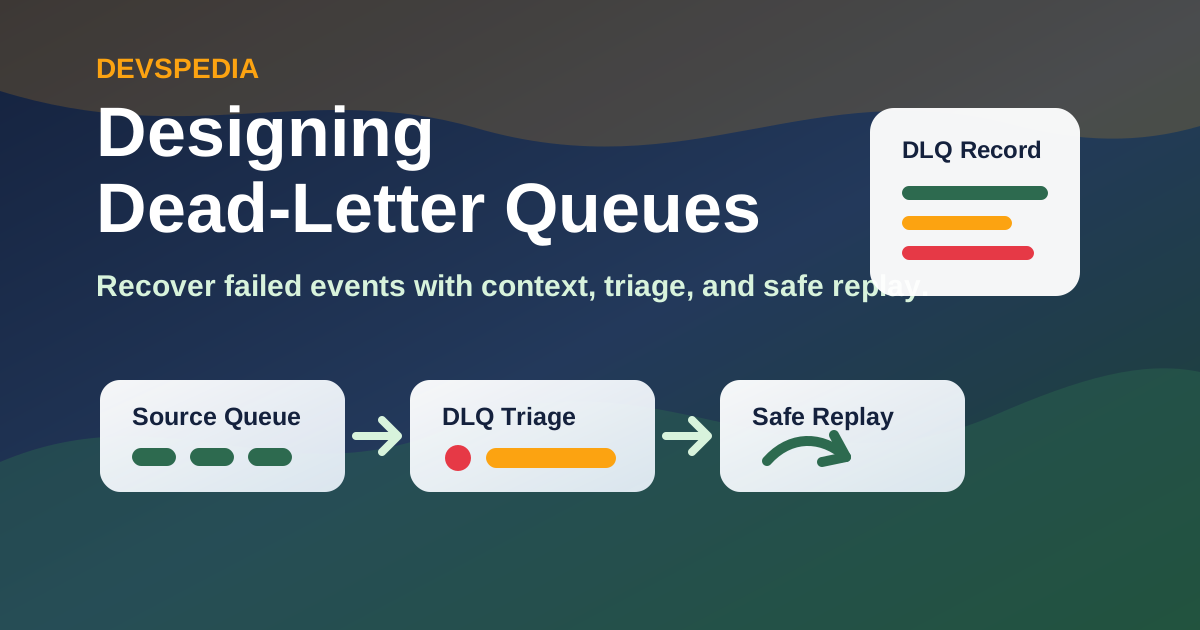
Introduction
Dead-letter queues are easy to add and easy to misuse. Most message brokers let you route failed messages somewhere else after a retry limit, but that only moves the problem. A dead-letter queue that nobody can inspect, classify, or replay is not a recovery mechanism. It is a backlog with a less alarming name.
A useful dead-letter queue, or DLQ, is designed around operations. It preserves enough context to explain why processing failed, gives teams a safe way to retry corrected messages, and exposes metrics before the queue becomes an incident. The goal is not to hide bad events. The goal is to make failure recoverable.
This article walks through a practical DLQ design for event-driven systems. The examples use JSON, SQL, and TypeScript-style worker code, but the same patterns apply to Kafka, RabbitMQ, SQS, Pub/Sub, NATS, and most queue-based architectures.
Why Messages End Up in a DLQ
Messages usually reach a DLQ for one of four reasons: the event is invalid, the consumer has a bug, a dependency is unavailable, or the message is valid but no longer processable. Those cases need different responses.
An invalid event might be missing a required field. Replaying it without fixing the producer will only fail again. A consumer bug might be fixed by a deployment, after which replay becomes safe. A dependency outage might need delayed retry rather than manual intervention. A stale message might need to be discarded after a business decision.
Treating all failures the same causes two common mistakes:
- Replaying poison messages repeatedly until they block worker capacity.
- Deleting failed messages without understanding whether data was lost.
Design the DLQ so every failed message can answer three questions:
- What failed?
- Who owns the fix?
- Can this message be replayed safely?
Store Enough Metadata to Debug
A raw event body is rarely enough. The DLQ entry should include the original payload, broker metadata, processing metadata, and the final error that caused the message to be moved.
Here is a compact DLQ record shape:
{
  "id": "dlq_01jz8w5q2n5s7",
  "sourceQueue": "invoice-events",
  "eventType": "invoice.paid",
  "eventVersion": 1,
  "messageId": "msg_9ab31",
  "correlationId": "req_274ad",
  "receivedAt": "2026-05-27T20:58:00.000Z",
  "failedAt": "2026-05-27T21:01:30.000Z",
  "attempts": 5,
  "consumer": "ledger-worker",
  "errorClass": "ValidationError",
  "errorMessage": "data.amountCents is required",
  "payload": {
    "type": "invoice.paid",
    "data": {
      "invoiceId": "inv_123",
      "amount": 49
    }
  }
}
Notice that the record keeps the original payload unchanged. If you later repair and replay the message, store the repaired payload as a separate object or create a new replay record. Do not overwrite the evidence you need for debugging.
Classify Failures Before Routing
Retries should be intentional. Some failures are worth retrying because they are temporary. Others should go straight to a DLQ because they are deterministic.
The worker can classify errors before deciding whether to retry, drop, or dead-letter the message:
type FailureAction = "retry" | "dead_letter" | "discard";

type ProcessingError = {
  name: string;
  message: string;
  retryable?: boolean;
  code?: string;
};

function classifyFailure(error: ProcessingError): FailureAction {
  if (error.retryable === true) {
    return "retry";
  }

  if (error.name === "ValidationError") {
    return "dead_letter";
  }

  if (error.code === "UNKNOWN_EVENT_VERSION") {
    return "dead_letter";
  }

  if (error.code === "BUSINESS_RULE_EXPIRED") {
    return "discard";
  }

  return "retry";
}
The default action depends on the system. For payments, orders, and account changes, a conservative default is usually retry with a strict cap, then DLQ. For low-value analytics events, discard may be acceptable after a few attempts. The important part is that the policy is explicit and reviewed.
Keep retry budgets small
A retry budget should prevent a single message from monopolizing the worker. For example, use three quick retries for transient network failures, then a delayed retry, then DLQ after the final attempt. Endless retries make outages noisier and hide the original failure rate.
Make the DLQ Queryable
Many teams start with the broker's built-in dead-letter destination. That is fine for routing, but operational triage usually needs a searchable store. Copy DLQ metadata into a table or indexed log so engineers can group failures by event type, consumer, and error class.
CREATE TABLE dead_letter_messages (
  id text PRIMARY KEY,
  source_queue text NOT NULL,
  event_type text NOT NULL,
  event_version integer,
  message_id text NOT NULL,
  correlation_id text,
  consumer text NOT NULL,
  attempts integer NOT NULL,
  error_class text NOT NULL,
  error_message text NOT NULL,
  payload jsonb NOT NULL,
  status text NOT NULL DEFAULT 'open',
  owner_team text,
  failed_at timestamptz NOT NULL,
  replayed_at timestamptz,
  discarded_at timestamptz
);

CREATE INDEX dlq_status_failed_idx
ON dead_letter_messages (status, failed_at DESC);

CREATE INDEX dlq_event_error_idx
ON dead_letter_messages (event_type, error_class);
This table does not need to replace the broker. It gives humans and automation a control plane: dashboards, alerts, runbooks, replay tooling, and ownership reports can all read from the same source.
Build Safe Replay Tools
Replay is where DLQ design becomes risky. Replaying a message can create side effects, especially when the original handler was not idempotent. A good replay tool should require classification, preview the selected messages, preserve audit history, and rate-limit the replay.
Here is a simplified replay function:
type DlqMessage = {
  id: string;
  sourceQueue: string;
  payload: unknown;
  status: "open" | "replayed" | "discarded";
};

async function replayMessage(message: DlqMessage, actor: string) {
  if (message.status !== "open") {
    throw new Error("Only open DLQ messages can be replayed");
  }

  await db.transaction(async (tx) => {
    await tx.insert("dead_letter_replay_audit", {
      message_id: message.id,
      replayed_by: actor,
      replayed_at: new Date(),
    });

    await broker.publish(message.sourceQueue, message.payload, {
      headers: {
        "x-replayed-from-dlq": message.id,
      },
    });

    await tx.update("dead_letter_messages", message.id, {
      status: "replayed",
      replayed_at: new Date(),
    });
  });
}
In production, add batch limits and a dry-run mode. The dry run should show the event types, error classes, age, and count before anything is republished. If a batch contains multiple failure classes, split the batch so one fix is validated at a time.
Repair without mutating history
Some messages need a small correction before replay. For example, an old producer might have emitted amount while the consumer expects amountCents. Store the repaired payload and the reason for the repair separately:
{
  "messageId": "dlq_01jz8w5q2n5s7",
  "repairReason": "Convert dollars to cents for legacy invoice event",
  "repairedBy": "platform-oncall",
  "repairedPayload": {
    "type": "invoice.paid",
    "data": {
      "invoiceId": "inv_123",
      "amountCents": 4900
    }
  }
}
That audit trail matters when a replay changes customer-visible state.
Alert on Trends, Not Just Queue Depth
Queue depth is useful, but it is not enough. A DLQ with ten payment messages might be urgent, while a DLQ with ten thousand disposable analytics events might be tolerable for a short period. Alerting should consider business impact, age, and failure pattern.
Track these signals:
- DLQ messages by event type and consumer.
- Oldest open DLQ message by queue.
- New DLQ rate compared with normal traffic.
- Repeated error classes after a deployment.
- Replay success and replay failure rates.
- Open messages without an owner team.
The oldest open message is especially valuable. It prevents a low-volume but important failure from hiding behind a small count.
Define retention deliberately
Retention is a product and compliance decision. Some messages can be discarded after a few days. Others may need to remain available until financial reconciliation, customer support, or audit windows are complete. Whatever policy you choose, document it and alert before messages expire.
Common Design Mistakes
Using the DLQ as a normal backlog
If workers cannot keep up, scale the workers or slow producers. Do not route healthy messages to the DLQ just to reduce pressure. A DLQ should represent failed processing, not overflow capacity.
Hiding ownership
Every DLQ entry should have an owner, even if ownership is inferred from the source queue or event type. Messages without owners become permanent clutter. Add routing rules that map event types to teams.
Replaying before fixing the cause
If the same validation error is still happening, replay will only add noise. Fix the producer, consumer, schema, or dependency first. Then replay a small sample, observe success, and continue in batches.
Losing correlation IDs
Correlation IDs connect the failed message to API requests, logs, traces, and customer reports. Preserve them from the original event or message headers. Without them, triage becomes guesswork.
Conclusion and Next Steps
A dead-letter queue is only useful when it helps the team recover. That means preserving context, classifying failures, making messages searchable, assigning ownership, and replaying with guardrails.
Start with one important queue. Add a structured DLQ record, capture the error class and correlation ID, expose a dashboard grouped by event type, and write a replay procedure that starts with a dry run. Once that workflow is reliable, extend it to other queues and make DLQ health part of normal service ownership.
About this story
This article was written by Gen-AI using GPT 5.5 or Opus 4.7. Verify technical guidance before using it in production systems.